.news-article,
.news-article * {
box-sizing: border-box;
}
.news-article {
max-width: 1080px;
margin: 0 auto;
padding: 18px 20px;
color: #333;
background: #fff;
font-family: "Public Sans", Helvetica, Arial, sans-serif;
font-size: 16px;
line-height: 1.75;
}
.news-article p {
margin: 0 0 14px;
}
.news-article h2 {
margin: 32px 0 16px;
padding: 9px 14px;
border-left: 4px solid #990000;
border-radius: 6px;
background: #faf5f5;
color: #990000;
font-size: 21px;
line-height: 1.45;
}
.news-article h3 {
margin: 22px 0 10px;
padding-left: 11px;
border-left: 2px solid #d9aaaa;
color: #990000;
font-size: 17px;
line-height: 1.5;
}
.news-article ul {
margin: 10px 0 18px;
padding: 14px 18px 14px 38px;
border-radius: 6px;
background: #fcfcfc;
}
.news-article li {
margin: 4px 0;
padding-left: 3px;
}
.news-article a {
color: #990000;
text-decoration: underline;
text-underline-offset: 2px;
}
.news-article .news-image {
margin: 18px 0 22px;
text-align: center;
}
.news-article .news-image img {
display: inline-block;
max-width: 100%;
height: auto;
border-radius: 7px;
box-shadow: 0 8px 22px rgba(0, 0, 0, 0.14);
vertical-align: middle;
}
.news-article .news-table-wrap {
width: 100%;
margin: 14px 0 20px;
overflow-x: auto;
-webkit-overflow-scrolling: touch;
border-radius: 6px;
}
.news-article table {
width: 100%;
min-width: 620px;
border-collapse: collapse !important;
border-spacing: 0 !important;
border: 0 !important;
font-size: 15px;
}
.news-article th,
.news-article td {
padding: 10px 12px;
border: 1px solid #e8e1e1;
text-align: left;
vertical-align: top;
}
.news-article th {
background: #990000;
color: #fff;
font-weight: 600;
}
.news-article tbody tr:nth-child(even) td {
background: #fcfcfc;
}
.news-article .process-list {
display: flex;
flex-wrap: wrap;
gap: 8px;
margin: 12px 0 18px;
padding: 0;
list-style: none;
}
.news-article .process-list li {
flex: 1 1 175px;
margin: 0;
padding: 9px 12px;
border-radius: 6px;
background: #faf5f5;
color: #444;
}
@media (max-width: 640px) {
.news-article {
padding: 12px;
font-size: 15px;
}
.news-article h2 {
margin-top: 26px;
font-size: 19px;
}
.news-article .process-list {
display: block;
}
.news-article .process-list li {
margin: 6px 0;
}
}
Early-stage mineral exploration often begins with a practical challenge: prospective geology lies beneath cover, targets extend across a large area, and drilling budgets are limited. Exploration teams need subsurface information to decide where further investment is justified.
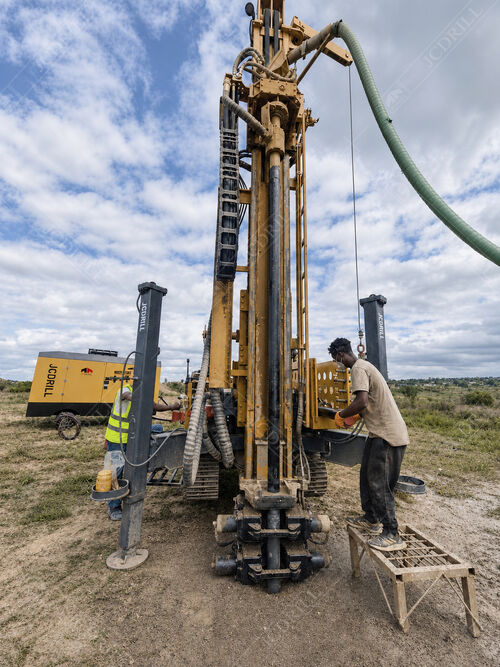
Air core drilling, also written as aircore or AC, is a drilling method that uses a rotating blade bit and compressed air to carry sample material to the surface through an inner tube.
Its effectiveness depends on more than drilling speed. Sample recovery, the geological questions being asked, and the point at which another drilling method is needed all matter.
1. What Is Air Core Drilling?
Air core drilling uses rotary action to cut through the ground. Compressed air helps clear the hole and transports cuttings through an inner tube to the surface for collection.
Technical reference: Alcoa Technical Report Summary
Aircore typically produces chips, particles, and fines rather than intact core. These samples can help identify lithology, weathering, alteration, and geochemical anomalies, but provide limited evidence of original rock fabric, fractures, and vein geometry.
2. How Aircore Works: Cutting and Sample Transport
The blade bit and the airflow perform two different functions. The blade bit uses rotary torque and axial load to cut the formation. Air clears the hole and transports the cuttings.
The blade bit cuts the formation
cuttings are generated
airflow carries them into the inner tube
the sample returns to the surface
material is collected, split, and logged by depth interval.
Aircore is generally suited to weathered or softer formations. Hard, competent rock can make drilling more difficult. Performance also depends on the drilling system and site conditions; no single factor determines whether the method will work well.
3. The Value of Sampling Beneath Cover
Aircore drilling helps exploration teams investigate geology beneath cover and gather information across a target area. The results can help teams decide where follow-up drilling should be focused.
Questions an aircore programme can help investigate include:
How thick is the cover sequence?
How does the weathering profile change with depth?
Which lithologies and alteration features occur beneath cover?
At what geological horizon does an anomaly appear?
Does the anomaly continue between neighbouring holes?
Where should follow-up drilling be concentrated?
Considering results across multiple holes can reveal patterns in the weathering profile and help put anomalies in geological context.
4. Suitable Ground Conditions and Common Limitations
Aircore can be useful in weathered and relatively easy-to-cut ground. Local geology and drilling conditions may affect penetration, sample return, and the ability to complete a hole.
Ground condition
Potential effect
Relatively uniform, readily cut weathered material
Supports steady penetration and consistent sample return
Sticky clay-rich material
May adhere to inner tubes and collection equipment, causing blockages and carryover
Gravel, boulders, or hard bands
May reduce penetration, increase wear, or cause early termination
Formations with substantial air loss
May reduce the airflow available to lift samples
Water-bearing intervals
May produce wet samples, adhesion, and splitting difficulties
Fresh, competent hard rock
Limits the effectiveness of conventional blade aircore drilling
When a blade bit reaches material it cannot penetrate effectively, the hole may stop before the planned depth. Field example: St Barbara Exploration Report
There is no universal maximum depth that applies to every aircore programme. Ground conditions, equipment configuration, and the required sample quality all affect what is achievable.
5. Why Inner-Tube Recovery Still Requires Quality Control
Incomplete recovery can change sample composition
If only part of the material from an interval is recovered, the sample may not represent the formation evenly. Assess the recovered quantity, particle size, and how the material relates to assay results.
Wet samples can complicate transport and splitting
Groundwater can make samples wet, causing material to adhere to equipment and complicating collection and splitting. Project reference: Catalyst Metals ASX Announcement
Residual material can contaminate subsequent intervals
Material left in the inner tube or collection equipment may carry over into a subsequent sample. Cleaning between intervals helps limit this risk.
Subsampling affects representativeness
Splitting and subsampling methods affect the material retained for analysis. Quality-control checks help assess whether the samples are representative of their logged intervals.
6. Aircore vs RAB, RC, and Diamond Drilling
Feature
Aircore
Common single-wall RAB
Common downhole-hammer RC
Diamond drilling
Main drilling action
Rotary blade cutting
Rotary cutting or percussion, depending on configuration
Percussion combined with rotation
Annular cutting to recover core
Typical sample return
Through an inner tube
Between the drill rods and borehole wall
Through an inner tube
Core retained within a core barrel
Typical ground suitability
Unconsolidated and weathered materials
Depends on bit and equipment configuration
Includes harder rock formations
Formations requiring core recovery
Main sample form
Chips, particles, and fines
Cuttings
Rock chips
Cylindrical core
Common exploration role
Cover investigation and initial anomaly delineation
Preliminary investigation
Mineralisation testing and deeper drilling
Detailed geological interpretation and structural information
Aircore itself uses reverse-circulation sample return. In common usage, “RC drilling” refers to dual-wall reverse-circulation drilling using a downhole hammer.
The distinction between methods involves the cutting or rock-breaking mechanism and the ground conditions each method suits, as well as the sample-return arrangement. Method definitions: Novo Resources
Drilling method selection depends on the geological setting, the information required, and the purpose of the exploration programme.
7. Assessing Cost: The Price of Useful Geological Information
Drilling cost is one part of an exploration programme. The usefulness of the information collected also matters when assessing the value of a drilling method.
What does it cost to obtain a reliable sampling interval that supports the next exploration decision?
The answer depends on project conditions, sample requirements, drilling performance, and the decisions the results need to support.
8. Designing an Aircore Programme That Supports Decisions
An effective programme should establish three things before drilling begins.
Define the geological objective
Set out the geological questions the drilling programme is intended to investigate and the information needed to address them.
Establish sample quality requirements
Consider the sample quality needed for the planned logging, analysis, and interpretation, including how samples will be collected and split.
Plan the follow-up pathway
Decide how results will inform the next stage of exploration. Incomplete recovery, multi-metre composite samples, and other sampling considerations should be evaluated in relation to the intended interpretation.
9. Interpreting Aircore Results Responsibly
An isolated result does not establish the size of a mineralised zone. Downhole length does not necessarily represent true thickness, and an anomaly needs to be interpreted in its geological context.
Aircore results are most useful when considered alongside sample quality, geological logging, neighbouring holes, and other available exploration information.
Conclusion
Aircore drilling offers a way to investigate geology beneath cover and collect samples across a target area. Its value depends on whether the method suits the ground conditions and whether the recovered samples are adequate for the geological questions being asked.
Understanding the method’s capabilities and limitations helps exploration teams interpret results and plan appropriate follow-up work.


 Votre message doit contenir entre 20 et 3 000 caractères!
 english
 français
 Deutsch
 Italiano
 Русский
 Español
 português
 Nederlandse
 ελληνικά
 日本語
 한국
 العربية
 हिन्दी
 Türkçe
 indonesia
 tiếng Việt
 ไทย
 বাংলা
 فارسی
 polski